 English
  Português
  Français
  العربية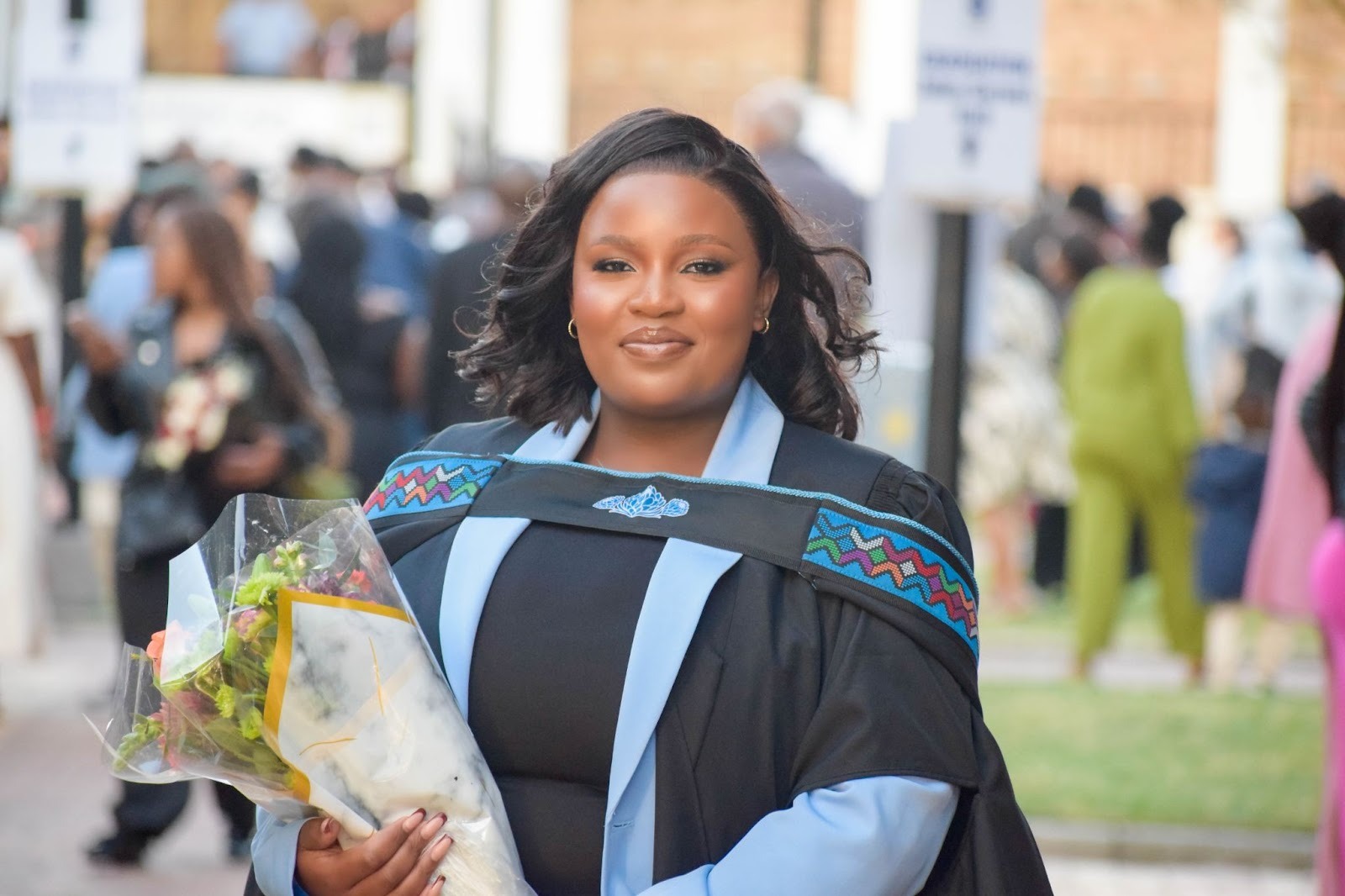
Lebogang Moropane is a PhD researcher in Environmental and Water Sciences whose work sits at the intersection of Earth observation, machine learning, and food security. Based in South Africa, her research focuses on understanding how non-perennial rivers support agricultural systems in semi-arid regions, and how big data analytics can inform better water governance and decision-making. She has actively engaged with Digital Earth Africa through training programmes and research projects, using the platform to develop practical, data-driven insights for real-world environmental challenges.
Briefly describe your academic background and research focus.
I have an academic background in Environmental and Water Sciences, having completed both my BSc Honours and MSc in this field. My MSc focused on assessing the impacts of invasive plants on groundwater-dependent ecosystems (GDEs) using remote sensing and machine learning techniques. My Honours research evaluated the accuracy of satellite-derived rainfall estimates (CHIRPS and TRMM) against rain-gauge measurements across different climatic zones in South Africa.
Currently, I am pursuing a PhD focused on harnessing big data analytics to understand the role of non-perennial rivers in supporting food security in semi-arid regions of Limpopo Province, South Africa. I have also participated in several summer schools, including the 5th Big Data Africa, Open Data for Social Impact Challenge, Waternet, and UKUDLA, which strengthened my understanding of how Earth observation combined with machine learning can be applied to real-world environmental and water-related challenges.
How did you discover Digital Earth Africa, and what drew you to its tools?
I discovered Digital Earth Africa during the 5th Big Data Africa Summer School, where the programme was structured around using the platform for all our projects. My team and I worked on mapping banana plantations across Africa using Earth observation data and machine learning.
What drew me to the platform was how intuitive and well-designed its tools are, especially the Python notebooks, which made it easy to work with large-scale datasets and build confidence in applying advanced analytics to real environmental problems.
What’s the focus of your current research or project, and how does EO data help?
My current PhD research focuses on understanding the role of non-perennial rivers in supporting agricultural production in Limpopo, South Africa. I am particularly interested in identifying which agricultural areas depend on these rivers, how water availability influences crop water productivity, and how this information can support better decision-making for food security and water governance.
Earth observation (EO) data is central to this work. I use satellite data to monitor river dynamics, vegetation health, rainfall, and groundwater conditions over time, which would be very difficult to capture through field data alone. By combining EO data with machine learning, I can analyse water use and productivity patterns at scale and develop practical, data-driven tools to support planners and extension officers in managing water resources under climate variability.
Which tools or datasets on DE Africa have been most useful in your work, and why?
The most useful datasets for my work have been Landsat-8 and Sentinel-2, as they provide the spatial detail and temporal coverage needed for environmental analysis. Combined with machine learning, these datasets allowed me to derive vegetation indices to identify groundwater-dependent ecosystems, assess their condition, and monitor the long-term expansion of invasive plant species.
Sentinel-2 and the Digital Elevation Model (DEM) were also key during the 5th Big Data Africa Summer School, where we used them to detect and map banana plantations across Africa. In addition, CHIRPS rainfall and soil moisture datasets helped add hydrological context, enabling a more integrated understanding of water-vegetation interactions.
Can you share one achievement or insight that DE Africa helped make possible?
One key achievement made possible through Digital Earth Africa was completing my MSc degree with distinction and producing publishable research outputs. The platform provided access to high-quality Earth observation data and analysis-ready tools, allowing me to focus more on robust analysis rather than data preparation. This efficiency supported timely completion of my degree and contributed to generating results suitable for peer-reviewed publications.
Have you collaborated with others through DE Africa? How has that shaped your work?
Yes, I have collaborated with others through Digital Earth Africa, particularly during the 5th Big Data Africa Summer School. I worked with team members from diverse backgrounds, including computer science, social sciences, mathematics, and data science. This interdisciplinary collaboration helped us solve problems more efficiently, as each person contributed specific expertise.
Beyond that, sharing and discussing Digital Earth Africa with peers from different disciplines has led to additional collaborative projects. These interactions have expanded how I use the platform and exposed me to new applications, methods, and perspectives that continue to shape my research approach.
What’s the biggest challenge you see for EO adoption in African research, and any ideas to overcome it?
The biggest challenge for EO adoption in African research is the lack of awareness and exposure, which is strongly rooted in an outdated, colonial education system. This system continues to shape how science and careers are framed, with heavy emphasis on traditional disciplines and limited exposure to emerging fields such as Earth observation, data science, and machine learning. As a result, many young people and decision-makers remain unaware of EO and its relevance to African development challenges.
To overcome this, there needs to be a deliberate shift towards modernising school curricula, particularly at high school level. Introducing EO, remote sensing, and data-driven problem-solving early on would help close awareness gaps, broaden career pathways, and empower young Africans with skills aligned to Africa’s own research and development priorities.
What would you like to see DE Africa achieve next for researchers across the continent?
I would like to see Digital Earth Africa further expand its training, outreach, and capacity-building efforts, especially for students and early-career researchers. Making advanced EO and data science skills more accessible, while continuing to simplify tools and workflows, would help grow a stronger and more confident community of African researchers using EO to solve local challenges.
One piece of advice for a young researcher wanting to use DE Africa’s tools?
Don’t just use the tools, understand them. Take time to learn what each tool does, why it works, and how it fits into the bigger analytical workflow. That understanding builds strong, transferable skills and makes you a far more confident and effective researcher in the long run.